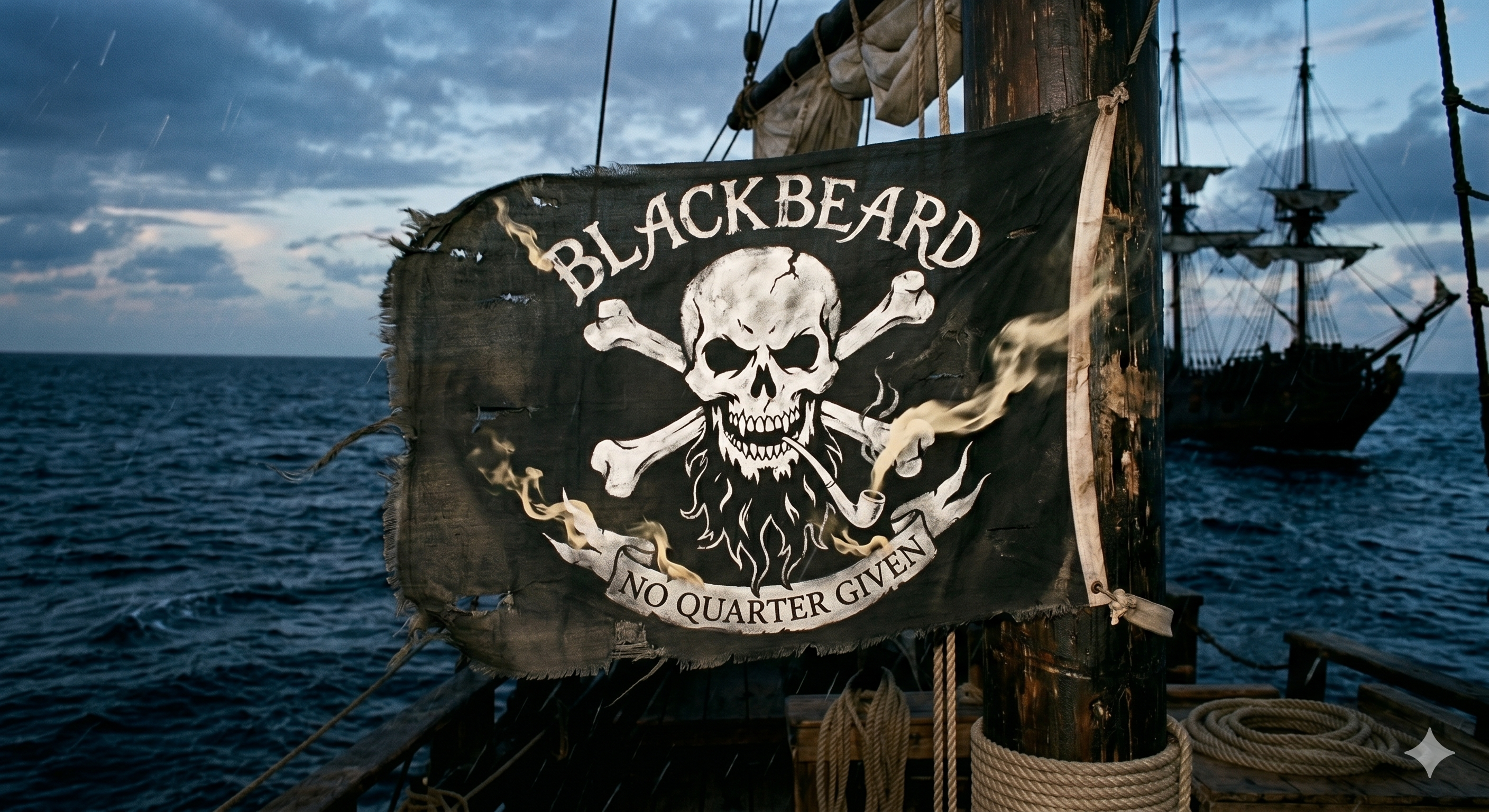
Blackbeard
Edward Teach — A Documented History
A fact-based historical report containing only information verifiable through primary documentary sources, archaeological evidence, and official records. No speculation, folklore, or unverified legends.
Contents
- Chronological Timeline 23 documented events, 1680–2023
- 1. Note on Sources Primary sources and their limitations
- 2. Early Life & Origins What is and is not documented
- 3. New Providence & Entry into Piracy Hornigold, Bonnet, and the pirate republic
- 4. Acquisition of Queen Anne's Revenge Capture of La Concorde
- 5. Enlargement of the Fleet Turneffe Island to the Carolinas
- 6. Blockade of Charles Town The 1718 hostage crisis
- 7. Grounding at Beaufort Inlet Deliberate or accident?
- 8. Pardon at Bath Town Royal pardon and return to piracy
- 9. Alexander Spotswood's Expedition The unauthorized military operation
- 10. The Battle of Ocracoke 22 November 1718
- 11. Aftermath & Trial of the Crew Executions and political fallout
- 12. The Wreck of Queen Anne's Revenge Discovery, identification, artifacts
- 13. Legal Disputes Allen v. Cooper and Blackbeard's Law
- 14. Bibliography & Sources Primary, secondary, archaeological, legal
Chronological Timeline
All events sourced from colonial government records, depositions, Admiralty court proceedings, archaeological reports, and official legal documents. Unverified claims are labeled as such.
Note on Sources
The documentary record for Edward Teach's life is sparse. No portrait of him was made during his lifetime. The famous 1736 engraving in A General History of the Pyrates was created 18 years after its subject's death and its accuracy cannot be confirmed. No log books, personal letters from Teach himself, or firsthand descriptions from people who knew him before his piratical career are known to survive.
Primary Sources
- A General History of the Pyrates (1724) by "Captain Charles Johnson" — Published two years after the battle at Ocracoke. The author's true identity is unknown. The book was a commercial publication and its accuracy varies. Where Johnson's claims can be checked against official records, some details have proven unreliable while others have been corroborated.
- The Boston News-Letter — North America's only newspaper at the time of Teach's activities.
- Depositions and affidavits — Including those of Captain Henry Bostock (held captive aboard QAR, December 1717), David Herriot, and Ignatius Pell.
- Colonial government records — Correspondence, proclamations, and dispatches from the governors of Virginia, North Carolina, South Carolina, Pennsylvania, and the Bahamas, as well as Admiralty court records.
- Archaeological evidence from wreck site 31CR314 — Recovered and analyzed by the North Carolina Department of Natural and Cultural Resources and Intersal, Inc., beginning in 1996.
Where this report labels something as "reported" or "alleged," it indicates the claim rests on a source of that reliability. Where multiple independent primary sources confirm a fact, it is presented as established.
Early Life & Origins
Nothing about Edward Teach's life before approximately 1716 is documented with certainty. All details of his early life come from sources recorded years later.
Name
In the earliest surviving records of his piratical activity, he is referred to as "Thatch" or "Thatche" (Capt. Mathew Munthe's report, 1717; multiple depositions). The spelling "Teach" appears in dispatches published in The Boston News-Letter. Other recorded spellings: Thach, Thache, Thack, Tack, Thatche, Theach. In a letter found on his body after death, addressed to him by Tobias Knight (Chief Justice and Secretary of the Province of Carolina), the name used was "Teach." Pirates commonly used fictitious surnames. His birth name is not documented.
Birth and Age
At death (22 November 1718), no exact age was recorded. Estimates placed him between 35 and 40, placing birth around 1680, but this is an approximation based on physical appearance, not documentation.
Place of Origin
The claim of Bristol, England parentage is widely repeated in secondary sources but rests on thin documentary ground. Author Robert Lee (1974) argued for Bristol partly because Teach was literate (uncommon for common sailors) and partly because Bristol was a major maritime city. No baptismal record, census entry, or other document linking a person named Teach/Thatch to a specific birthplace has been produced.
Literacy
It is documented that Teach could read and write. A letter addressed to him by Tobias Knight was found among his possessions after the battle at Ocracoke. Literacy was not universal among sailors and is consistent with a background above the lowest social classes.
Pre-Piratical Maritime Service
Charles Johnson (1724) states that Teach served aboard privateer vessels operating from Jamaica during the War of the Spanish Succession (Queen Anne's War, 1702–1713). This claim appears only in Johnson's account and cannot be independently verified.
Summary of Unknowns
No records survive of Teach's family, childhood, education, or maritime career before 1716.
New Providence & Entry into Piracy
New Providence. After the Treaty of Utrecht ended the War of the Spanish Succession (1713), many privateers lost their legal employment. A large number settled on New Providence in the Bahamas, which had no effective colonial government. By 1716, the island hosted a substantial population of former privateers and pirates preying on shipping through the Florida Strait. Its harbor could shelter hundreds of small vessels but was too shallow for large Royal Navy ships. When Governor Woodes Rogers arrived to offer pardons in 1718, approximately 200 pirates surrendered on a single day.
Benjamin Hornigold
In 1716, Teach joined the crew of Captain Benjamin Hornigold, a pirate operating from New Providence. Hornigold placed Teach in command of a captured sloop. In early 1717, the two captains sailed together along the North American coast, documenting several joint captures:
- A boat carrying flour out of Havana
- A Bermudian sloop carrying wine
- A vessel from Madeira to Charles Town (the Betty of Virginia)
The earliest surviving official record of Teach as a functioning pirate is a report by Capt. Mathew Munthe, who conducted an anti-piracy patrol off North Carolina. Munthe recorded "Thatch" operating a sloop with 6 guns and about 70 men, independently of Hornigold.
Stede Bonnet
Teach and Hornigold encountered Stede Bonnet's ship Revenge around September 1717. Bonnet was a wealthy Barbadian landowner who had purchased a sloop and turned to piracy despite having no known sailing experience. His crew was dissatisfied with his command. Bonnet agreed to transfer command of the Revenge to Teach. The combined operation now included three ships.
Hornigold's Retirement
Toward the end of 1717, Hornigold retired from piracy after restricting his attacks to French and Spanish vessels — his crew objected. He accepted the King's pardon and later became a pirate hunter. Whether Teach played any role in this decision is not documented.
Acquisition of Queen Anne's Revenge
On 28 November 1717, off the coast of Saint Vincent, Teach's two ships attacked the French vessel La Concorde. After both pirate ships fired broadsides — killing several of the French crew — the French captain surrendered. This engagement was reported by multiple parties and is documented in the historical record.
La Concorde / Queen Anne's Revenge — Specifications
| Attribute | Value |
|---|---|
| Original Name | La Concorde (originally English Concord, captured 1711) |
| Type | Frigate, full-rigged |
| Tonnage | 200 tons burthen |
| Dimensions | 103 ft × 24.6 ft (31.4 m × 7.5 m) |
| Built | c. 1710, French construction |
| Crew (under Teach) | ~300 men |
| Armament | ~40 cannons (30 recovered to date) |
| Prior Service | French naval, merchant, and slave vessel under Rene Montaudin of Nantes |
Teach sailed La Concorde to Bequia, where the French crew and the ship's cargo of enslaved people were disembarked. Teach gave the French crew his smaller sloop as a replacement. He renamed the captured ship Queen Anne's Revenge, armed her with approximately 40 cannons, and crewed her with ~300 men.
Whether Teach took any enslaved people aboard is not clear from the primary sources. Johnson (1724) states some were kept, but Johnson is not always reliable on such details. The French crew later retook some from the island using the replacement sloop.
Subsequent Captures Using QAR
- Off Saint Vincent (late Nov 1717): After a lengthy engagement, the merchant ship Great Allen surrendered. Crew disembarked, cargo emptied, vessel burned and sank. Reported in the Boston News-Letter.
- 5 December 1717: The merchant sloop Margaret (Capt. Henry Bostock) was stopped near Crab Island. Crew held ~8 hours. Bostock was released unharmed and gave the earliest surviving deposition describing Teach's physical appearance.
Enlargement of the Fleet
Turneffe Island (March 1718). While taking on water at Turneffe Island (east of Belize), Teach's ships spotted the Jamaican logwood-cutting sloop Adventure. The vessel was stopped. Captain David Harriot and crew joined the pirates. Teach placed Israel Hands in command of the Adventure. Source: Harriot deposition.
Bay of Honduras. The fleet sailed to the Bay of Honduras, where they added at least one more ship and several sloops.
April 1718 Captures.
- 9 April: looted and burned Protestant Caesar (documented in ship records)
- Grand Cayman: captured a small vessel
- Wrecks of the 1715 Spanish treasure fleet off eastern Florida
- Captured a small Spanish vessel near Havana
Teach sailed north toward Charles Town, South Carolina, capturing at least three documented vessels along the way. By May 1718, Teach styled himself Commodore and commanded a flotilla of up to eight vessels carrying several hundred men.
Blockade of Charles Town
In May 1718, Teach's fleet blockaded the port of Charles Town (Charleston), South Carolina. The blockade lasted approximately five to six days. All vessels entering or leaving the port were stopped. The pilot boat was captured first.
The Hostage Crisis
The most consequential capture was the ship Crowley, carrying prominent Charles Town citizens including Samuel Wragg, a member of the provincial council. Passengers were questioned about shipping in port and confined below decks for about half a day.
Teach demanded medical supplies from the colonial government, threatening that if none were forthcoming, all prisoners would be executed, their heads sent to the Governor, and all captured ships burned.
Wragg agreed to the demands. A Mr. Marks and two pirates were given two days to collect the medicines. The delivery was delayed — Marks's boat capsized; the two pirates had gotten drunk with friends and had to be retrieved. When Marks finally returned, Teach kept his word: the captured ships and prisoners were released unharmed (though relieved of their valuables).
No one was killed or physically harmed during the entire blockade. This is consistent with the absence throughout the historical record of any documented case of Teach personally killing a captive. Source: Wragg and other depositions; Boston News-Letter.
Grounding at Beaufort Inlet
After Charles Town, Teach learned that Woodes Rogers had been dispatched from England with warships to suppress piracy in the Bahamas. His fleet sailed north along the Atlantic coast into Beaufort Inlet (then Topsail Inlet), off the coast of North Carolina, to careen the ships.
On 10 June 1718, Queen Anne's Revenge ran aground on a sandbar. The mainmast cracked and the hull timbers were severely damaged. Teach's sloops attempted to free her, but the sloop Adventure also ran aground. Both ships were seriously damaged. Source: David Herriot's deposition.
Deliberate or Accident?
At the trial of Stede Bonnet's crew (1719), boatswain Ignatius Pell testified under oath: "The ship was run ashore and lost, which Thatch [Teach] caused to be done." This is a direct primary-source accusation of intentional grounding, from a crewman on trial for his life. Modern historians have inferred motives (reducing crew to increase shares), but no primary source states Teach's reason.
After the grounding, Teach transferred plunder and men to smaller vessels and marooned approximately 25 men on a small sandy island. Stede Bonnet rescued them two days later upon returning from his own pardon.
Pardon at Bath Town
In 1717–1718, King George I issued the Acts of Grace offering pardons to pirates surrendering by 5 September 1718.
Stede Bonnet sailed to Bath Town (Bath, North Carolina) and surrendered to Governor Charles Eden, receiving his pardon. He returned to Beaufort Inlet to retrieve his ship Revenge, only to find Teach had stripped it and marooned the crew. Bonnet attempted to pursue Teach, failed, returned to piracy, was captured 27 September, tried, and hanged.
Edward Teach surrendered to Gov. Eden at Bath in June 1718 and received his pardon. He settled near Bath Creek at Plum Point. He was given legal title to his remaining sloop, renamed Adventure. He applied for permission to sail to St. Thomas for a privateer's commission.
Return to Piracy
By August 1718, Teach was again capturing ships. He seized two French vessels, told Eden he found one derelict at sea, and the Vice Admiralty Court awarded spoils. Source: Court records.
At Ocracoke, Teach rendezvoused with fellow pirate Charles Vane (who had rejected the pardon), along with Israel Hands and Robert Deal. The gathering alarmed Pennsylvania's governor, who dispatched two sloops.
Alexander Spotswood's Expedition
Governor Alexander Spotswood of Virginia learned of Teach's presence near the VA–NC border. He arrested Teach's former quartermaster William Howard and obtained Teach's location. Howard was tried by Vice Admiralty Court in Virginia and found guilty. His attorney John Holloway challenged the court's jurisdiction. Howard was ultimately saved by a commission from London directing governors to pardon surrendering pirates.
The Expedition
Spotswood personally financed and organized the attack without authorization from North Carolina. He ordered Captains Gordon and Brand of HMS Pearl and HMS Lyme to travel overland to Bath. Lieutenant Robert Maynard of HMS Pearl was given command of two commandeered sloops to approach Ocracoke by sea (the warships were too large for the shallow waters). Maynard had 57 men from both ships. 17 November 1718: the sloops departed the James River.
Brand's overland force reached Bath on 23 November and informed Gov. Eden of the operation. Brand's scouts located Teach at Ocracoke and reported back on 24 November.
The Battle of Ocracoke
Maynard found the pirates anchored on the inner side of Ocracoke Island on the evening of 21 November 1718. He blocked the inlet and posted lookouts. Teach had not posted lookouts. Israel Hands was ashore in Bath with ~24 sailors. Teach's crew aboard: Capt. Brand's report to the Admiralty states "13 white and 6 Negroes" — 19 total.
The Engagement — 22 November 1718, Daybreak
Teach cut anchor cable and maneuvered. His first broadside was devastating: approximately 20 of Maynard's men on Jane killed or wounded; 9 casualties on Ranger. Lieutenant Hyde was killed; his sloop was disabled.
Maynard had concealed most of his men below deck. When Teach's men boarded Jane, they initially saw what appeared to be an empty ship. Maynard's crew burst from the hold. Hand-to-hand combat followed. Teach and Maynard engaged directly — flintlocks, then cutlasses. Teach broke Maynard's cutlass but was attacked by multiple crew members. He sustained five gunshot wounds and approximately twenty cutlass wounds before being killed.
The remaining pirates quickly surrendered. Final casualty counts:
| Source | Maynard's Men Killed | Pirates Killed |
|---|---|---|
| Maynard's Report | 8 | 12 |
| Brand's Admiralty Report | 11 | 10 |
| Spotswood's Account | 10 | 10 |
Aftermath of the Battle
Maynard found documents on Teach's body, including a letter from Tobias Knight. Teach's body was thrown into the inlet. His head was suspended from Maynard's bowsprit to claim the bounty, then displayed at the entrance to the Chesapeake Bay for years as a warning.
Maynard's disappointment: The ~£400 prize money was split between HMS Lyme and HMS Pearl crews — Maynard, who bore the brunt of the fight, considered this unfair. Payment was delayed four years. Maynard was never promoted and faded from the historical record.
Aftermath & Trial of the Crew
Maynard's captured pirates were transported to Williamsburg. They were tried under admiralty law at the Capitol building on 12 March 1719. Fourteen of sixteen accused were found guilty and hanged. Their bodies were displayed in gibbets along Capitol Landing Road (known as "Gallows Road").
Two were acquitted: one proved he had been merely a guest aboard the Adventure the night before the battle; the other, Israel Hands, was not present (he was in Bath) and was covered by the prior royal pardon.
Tobias Knight Investigation
Spotswood accused North Carolina Chief Justice Tobias Knight of colluding with Teach. At Bonnet's crew trial, several witnesses testified Knight received goods from Teach. A letter from Knight to Teach was found on Teach's body. Knight was formally investigated but cleared by his governing board. He died later in 1719.
Political Fallout
Governor Eden resented Spotswood's unauthorized military operation in North Carolina. The inter-colonial dispute continued until Eden's death on 17 March 1722. Spotswood was replaced as governor in 1722.
The Wreck of Queen Anne's Revenge
On 21 November 1996, private research firm Intersal, Inc. discovered a shipwreck in 28 feet of water, ~1 mile offshore of Fort Macon State Park, Atlantic Beach, NC (34°41'44"N, 76°41'20"W). Site designated 31CR314. Identified as Queen Anne's Revenge on 29 August 2011.
Evidence for Identification
- French construction techniques (fastening patterns, French foot measurements)
- Brass coin weight bearing bust of Queen Anne (reigned 1702–1714)
- Wine glass stem decorated with crowns, commemorating 1714 coronation of George I
- French hunting sword with bust resembling Louis XV (took throne 1715)
- Urethral syringe with Paris maker's mark, dated 1707–1715
Cannons
30 cannons identified (24 recovered). Mixed origin — English and Swedish — consistent with a pirate vessel accumulating armament from captures. One carries the English founder's mark of John Fuller (Heathfield Furnace, East Sussex); four carry Swedish marks of Jesper Eliaeson Ehrencreutz (Södermanland), dated 1713.
Artifacts
By 2013: approximately 280,000 artifacts recovered including a 0.9-tonne anchor, ceramics, pewter, cannon apron, sword guard, coins, and ballast stones. In 2018: 16 fragments of paper recovered from inside a cannon, identified as pages from A Voyage to the South Sea, and Round the World (1708–1711) by Capt. Edward Cooke, used as cannon wadding.
The wreck was added to the U.S. National Register of Historic Places on 9 March 2004 (#04000148). Artifacts displayed at the North Carolina Maritime Museum (Beaufort), with loans to the Smithsonian and the Musée national de la Marine (Paris).
Legal Disputes
Ownership. The State of North Carolina claims ownership (wreck lies within state waters). In 1998, Intersal entered a memorandum of agreement with NCDNCR and MRI. Intersal forwent claims to coins/precious metals; received media and replica rights.
Allen v. Cooper
In 2013 and 2015, North Carolina posted videos of the wreck online without permission from Nautilus Productions (documenting recovery since 1998). Before posting, the NC legislature passed "Blackbeard's Law" (N.C. Gen Stat §121-25(b)), declaring all documentation of derelict vessels in state custody to be public record.
Nautilus sued for copyright infringement. The U.S. Supreme Court heard oral arguments 5 November 2019 and ruled 23 March 2020 in favor of North Carolina — the Copyright Remedy Clarification Act (1989) did not validly abrogate state sovereign immunity.
Nautilus filed new constitutional claims (5th and 14th Amendment). 30 June 2023: NC Governor Roy Cooper signed a bill repealing Blackbeard's Law.
Intersal Lawsuit
Intersal filed a separate breach-of-contract suit. In November 2019, the NC Supreme Court affirmed Intersal's right to proceed. February 2023: a judge ruled in Intersal's favor. Possible damages: $15.6M–$259.3M. Archaeological recovery ceased after the 2015 season due to the litigation.