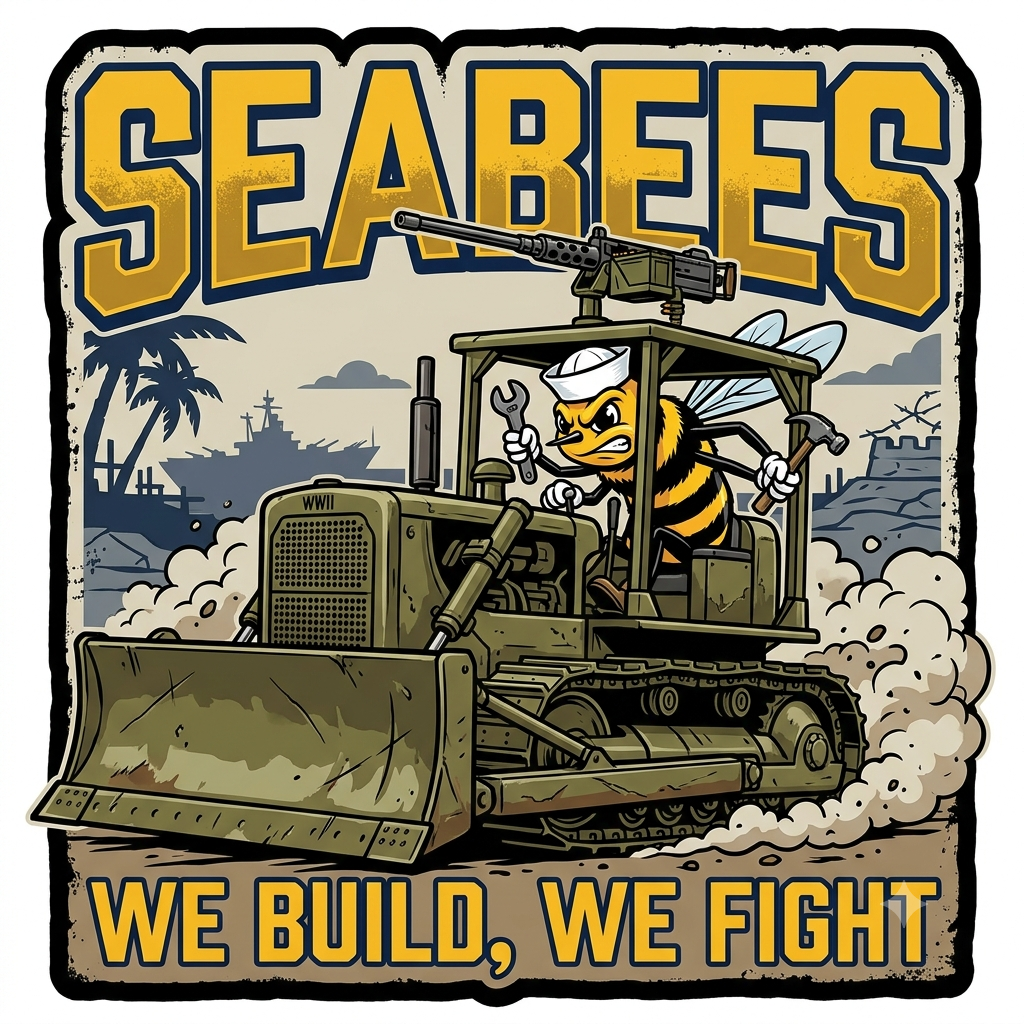
United States Naval Construction Battalions

We Build,
We Fight

*"Construimus, Batuimus"*

From the beaches of Normandy to the islands of the Pacific, the Seabees have built the backbone of American military power for over 80 years.

Explore Their Story

The Birth of the Seabees

The history of the United States Navy Seabees is one of the most rugged, practical, and vital chapters in modern military history. Born out of desperation in the dark early days of World War II, the Naval Construction Battalions (CBs) took civilian trade skills, threw on a uniform, and built the literal runways, roads, and bases that allowed the Allies to win.

⚖️

The Legal Crisis of 1941

Before Pearl Harbor, civilian contractors built overseas bases but could not legally resist enemy attack — they could be executed as "insurgents." After Wake Island, where hundreds were taken prisoner, Rear Admiral Ben Moreell created a militarized construction force.

January 5, 1942

🐝

The Name & The Logo

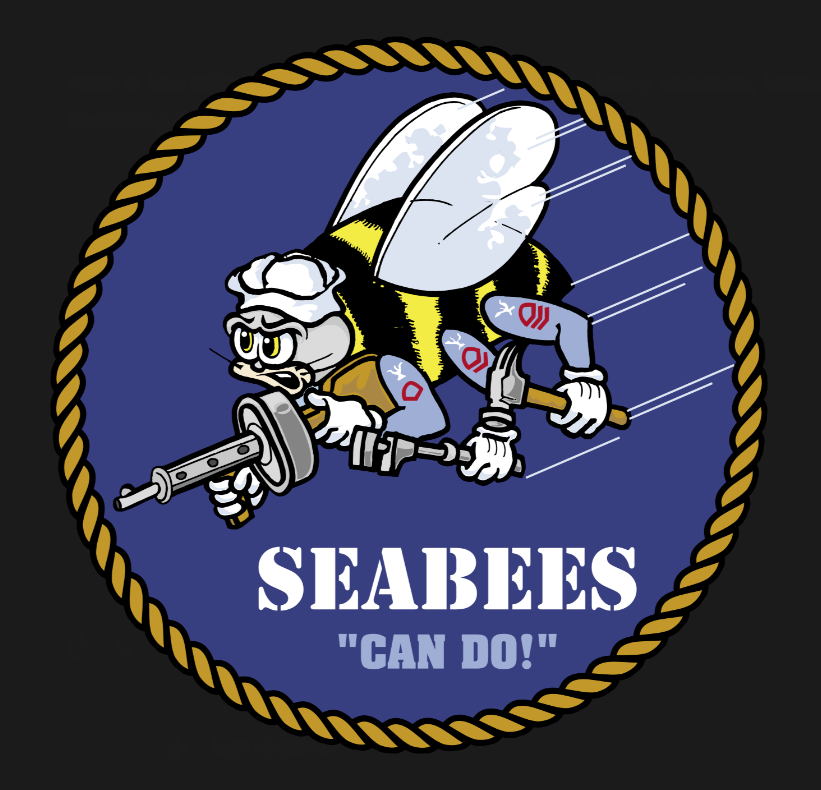
"Seabee" comes from the initials C.B. (Construction Battalion). Frank Iafrate, a civilian file clerk at Camp Endicott, designed the iconic logo: a buzzing bee wearing a sailor's hat, holding a Tommy gun, a wrench, and a hammer.

👨‍🔧

The Original Builders

The average age of a Seabee during WWII was 37 years old. They recruited experienced civilian tradesmen — carpenters, electricians, heavy equipment operators — who already knew their crafts and were seasoned, tough men.

The Golden Era: World War II (1942–1945)

Over 325,000 men served in the Seabees during WWII. Their accomplishments across both major theaters were staggering.

Seabee Bulldozer Operation

The Pacific Theater

The Pacific war was a war of distances. Victory depended on airfields. The Seabees mastered landing right behind the initial Marine waves — sometimes with them — clearing jungles and laying runways in days while islands were still under fire.

  • Guadalcanal: Repaired Henderson Field under constant artillery and bombing raids.
  • Tinian: Built the largest airfield in the world — runways used by B-29 Superfortresses including the Enola Gay.

The European Theater

On D-Day, Seabees were among the first ashore at Normandy. Working in freezing, blood-stained water, they blew up underwater obstacles, operated Rhino ferries, and built the revolutionary Mulberry artificial harbors that made the invasion logistically possible.

  • Normandy: Cleared obstacles under direct fire on June 6, 1944.
  • Rhine Crossing: Ferried Patton's armored units across the Rhine into Germany.
Korea & Vietnam

Korean War (1950–1953)

After post-WWII downsizing, the Cold War proved a standing construction force was essential. At Inchon, Seabees braved extreme tides and mudflats to position pontoon causeways hours after the initial assault. They built and maintained Kimpo airfield, repeatedly repairing cratered runways to keep UN fighter jets in the air.

Vietnam War (1965–1975)

At its peak, over 26,000 Seabees were deployed to Southeast Asia. They built massive logistic complexes at Da Nang and Chu Lai, carved hundreds of miles of highways, and erected fortified camps. This era also saw the rise of Seabee Civic Action Teams (CATs) — building schools, digging wells, and pioneering "hearts and minds" warfare.

CM3 Marvin Shields became the first and only Seabee awarded the Medal of Honor. On June 10, 1965, at Dong Xoai, he fought for three hours while severely wounded, helping carry a critically injured officer to safety and destroying an enemy machine-gun nest before succumbing to his wounds.

The Modern Era

Diego Garcia

In the 1970s and 1980s, Seabees transformed a remote Indian Ocean atoll into a critical strategic military hub — one of the largest peacetime construction projects ever undertaken.

Desert Shield / Desert Storm

In 1990–1991, Seabees deployed to Saudi Arabia, building a 15,000-bed camp for the Marines — the largest wartime camp since WWII — plus highways, airfields, and ammunition supply points.

Global War on Terror

After 9/11, Seabees deployed to Afghanistan and Iraq, repairing battle-damaged runways, building forward operating bases, constructing bridge crossings over the Euphrates and Tigris, and reinforcing remote combat outposts.

Chronological Milestones

1942

The Birth of the Seabees

Rear Admiral Ben Moreell secures authority to form Naval Construction Battalions. The "Seabee" moniker and fighting bee emblem are born.

1944

D-Day & Normandy

Seabees land at Normandy to dismantle beach obstacles, run Rhino ferries, and build Mulberry artificial harbors under heavy fire.

1950

Battle of Inchon

Seabees break the tide and mud barrier, installing crucial pontoon causeways to land UN forces during the Korean War.

1965

Marvin Shields — Medal of Honor

CM3 Marvin Shields is mortally wounded defending a Special Forces camp in Vietnam, becoming the first and only Seabee to receive the Medal of Honor.

1970s–80s

Diego Garcia Project

Seabees transform a remote coral atoll into a critical strategic U.S. military hub in the Indian Ocean.

1990–91

Operation Desert Storm

Seabees build massive desert highways, airfields, and a historic 15,000-bed base complex in Saudi Arabia.

2001–2021

Global War on Terror

Seabees deploy to Iraq and Afghanistan, building FOBs, drilling wells, and repairing infrastructure under active combat conditions.

Deeper Into Seabee History

The Battle of Lang Vei

A 36-man Seabee Team from NMCB-11 was helicoptered into the remote Lang Vei Special Forces Camp near the Laotian border. They hardened the camp with 8-inch reinforced concrete walls and a massive ops bunker. When the NVA launched its infamous tank-led assault in 1968, these structures provided the vital stronghold for the surviving Green Berets.

Forging Racial Equality

The 34th and 80th Naval Construction Battalions became the first integrated and predominantly Black Seabee units. Frustrated by discrimination, these Seabees wrote to the NAACP and civilian leadership. Their exemplary service and internal resistance compelled the Navy to change its official racial policies.

Project Tektite: Space Under the Sea

In 1968–69, Seabees deployed to St. John, Virgin Islands to install a two-story underwater habitat for NASA. The project studied saturation diving techniques for future long-duration spaceflight — laying the blueprint for deep-ocean diving commands.

Specialized Detachments

The Navy created highly specialized units: CBMUs maintained advanced bases so battalions could move forward; Seabee Teams (13-man outfits) deployed within 48 hours for remote missions; and Underwater Construction Teams (UCTs) — Seabees who are also qualified deep-sea Navy Divers — execute underwater demolition, cable repair, and harbor clearance at depths of 150+ feet.

The Myth of "Island X"

During WWII, security was so tight that Seabee shipping orders read only "Island X" — representing any remote, unnamed Pacific atoll where a battalion would land with limited supplies and build an advanced base from scratch out of local timber and crushed coral.

The Seabee — SEAL Connection

The lineage of the modern Navy SEALs is deeply intertwined with the Seabees. While SEAL teams were officially established in 1962, their direct ancestors were the Naval Combat Demolition Units (NCDUs) and Underwater Demolition Teams (UDTs) of World War II — and the Seabees were their primary founders.

The Camp Peary Dynamite School

In 1943, the Navy needed teams to clear underwater beach obstacles before invasions. The entire inaugural class — 6 officers and 18 enlisted men — was drawn directly from the Seabees' Dynamiting and Demolition School at Camp Peary, Virginia.

Draper Kauffman & "Hell Week"

LCDR Draper Kauffman recruited Seabee volunteers for "hazardous, prolonged, and distant duty." His brutal "Introduction Week" compressed an entire 8-week PT program into a single sleep-deprived week. This evolved directly into "Hell Week" in modern BUD/S training. Attrition was 65–75%. The tough civilian tradesmen of the Seabees formed the backbone of those who survived.

NCDU Structure

Each NCDU consisted of 6 men: one officer (typically from the Civil Engineer Corps — the officer corps of the Seabees) and five enlisted Seabee demolition specialists.

D-Day: The Proof

On Omaha and Utah beaches, 34 NCDUs suffered a 52% casualty rate (37 killed, 71 wounded) — the bloodiest day in Naval Special Warfare history. Despite this, they blew gaps through the Atlantic Wall. Not a single man was lost to mishandled explosives — a testament to Seabee training.

From Frogmen to SEALs

The NCDUs evolved into Underwater Demolition Teams (UDTs) — Seabee "Frogmen" who swam into enemy surf zones to clear channels. When the Navy SEALs were activated in 1962, their initial rosters were filled by active UDT members whose entire training pipeline was built by Seabees.

1943 — Seabee Dynamite School
NCDUs
(Cleared Normandy)
UDTs — "Frogmen"
(Pacific Theater)
1962 — Navy SEALs

The Seabee Legacy Today

Organized into Naval Construction Regiments (NCRs) and Naval Mobile Construction Battalions (NMCBs), the Seabees split their time between tactical military engineering, global humanitarian aid, and disaster relief.

Military Engineering

Building forward operating bases, runways, bridges, and infrastructure in active combat zones worldwide.

Humanitarian Aid

Building schools, digging wells, repairing hospitals, and training local communities in construction skills across developing nations.

Disaster Relief

Clearing roads after hurricanes, restoring ports after earthquakes, and re-establishing critical infrastructure after natural disasters.

"The difficult we do immediately; the impossible takes a little longer."

— Seabee Motto